
Takeaways from Our Recent Trip to Israel: First Five Takeaways - 5/30/25

Dear Friends,
My wife, Susan, and I just returned from two weeks in Israel. It was Susan’s first time there, and my first trip since the October 7, 2023 invasion of Israel. An earlier group trip that we had planned to go on was unfortunately cancelled due to security reasons following Israel’s limited bombing of Iran in retaliation for Iran’s major first missile barrage against Israel in April 2024.
Our trip to Israel had two components. We spent one week with AIPAC[1] focused on the events of October 7 and their aftermath, and another week with a private guide, Yuval Zelinkovsky, who we couldn’t recommend more highly and have toured with in the past. I wanted to share with you our top 20 takeaways from the trip.
The takeaways will be more personal in nature, reflecting what Susan and I saw and experienced. I have decided to largely shy away from what we learned from our many meetings with senior Israeli officials, high-ranking IDF officers, and prominent journalists and academics over the course of our visit.
For those of you who have been to Israel often, many of these observations won’t surprise you. But for those of you who have never been or have not been to Israel post-October 7, I think you will find many of our takeaways quite surprising. Where appropriate, I have included photos that bring the comments to life. I will be sharing my takeaways in four separate monographs, each containing five takeaways, that will be published every two to three days.
Please note that unfortunately on Substack.com, the footnotes – which I think add a great deal of background information and depth – can only be found at the end of the monograph. On the PDF version, the footnotes are shown on the page upon which they first appear, making them easier to access and integrate while reading the monograph. Please also note I have attached a PDF version at the end for those of you who prefer to print it out and read it in that format.
1. Israel Is Being Economically Isolated and Feeling the Pain: People often speak about Israel fighting a seven-front war, but those are only the military threats.[2] On top of these military threats are three non-military fronts: legal warfare intended to delegitimize Israel as a Jewish state, media warfare – both in traditional media and on social media – to discredit Israel in the eyes of the world, and economic warfare designed to economically and culturally isolate Israel. The most visible form of this is the Boycott, Divest, and Sanction (BDS) movement which is meant to stop all global trade with Israel. However, the threat is both deeper and more imminent than just that posed by BDS.
A major component of the Israeli economy is tourism. While in Israel, we witnessed the negative impact on the Israeli economy of a single ballistic missile fired from Yemen on May 4, seven days before our arrival. The missile managed to evade Israeli air defenses and land near Ben Gurion Airport. Almost immediately, all major U.S. airlines stopped flying to Israel, isolating the country.[3] And, unfortunately, the airlines seem to be in no rush to resume service anytime soon.
The negative economic impact from that single Houthi missile which eluded Israeli defenses, and the war in general, has been significant – our three hotels were largely empty, stores catering to tourists are suffering, and tour guides all commented on how little they have worked since October 7. It was evident to Susan and me that large segments of the Israeli economy are hanging on by a thread.
2. Our Coming to Israel Was a Big Deal: I can’t begin to tell you how many Israelis thanked us for coming to Israel and told us how much it meant to them that we were here. And it wasn’t just people directly impacted by the absence of tourists like hotel staff or tour guides. Ordinary Israelis told us over and over again how much they appreciated our being here – waiters at restaurants, storekeepers, and even people we met in chance encounters on the street.
Our kids had urged us not to travel to Israel, saying that it was reckless on our part and unsafe. Seeing the reaction of the ordinary Israelis we encountered vindicated our decision to come. It was a great, great decision to be here in Israel and it felt very meaningful to show our support. Unlike the perception outside of Israel, it felt very safe. As an aside, if you don’t like lines, this is the perfect time to go to Israel.
Moreover, in case there is any confusion on this score, Israel is fighting on behalf of all of us… and by this I don’t mean simply the Jews in the diaspora living around the world. Israel is the head of the spear, fighting against the forces of religious extremism and Islamofascism seeking to destroy Western civilization. Israel is but the first necessary step for them in this campaign of destruction. Death to Israel and Death to America are not empty chants.
3. Israel Is More Diverse Than New York City: The description of Israel as a country of white, European colonialists is so far from the truth that it is laughable. Yet that is the narrative among large segments of the population around the world, which describes Israel as an apartheid state. Muslim Israelis, which comprise 18% of the population, along with Druze, Christian, and other minorities, all have the same rights in Israel as Jewish Israelis – the right to vote, the right to serve in the Knesset (the Israeli parliament), and equal rights under the law, including the right to education, healthcare, and social services.
Even setting all this aside, all you have to do is walk the streets of Jerusalem or Tel Aviv for just 10 minutes to know how ludicrous this claim is. In the markets of Jerusalem, we saw Muslim shopkeepers next to Jewish shopkeepers – who we were often unable to tell apart – surrounded by people of every race, nationality, and religion interacting peacefully together. In fact, the streets of Jerusalem make the bar scene in the movie, Star Wars, look positively tame by comparison.[4]
Even among the 76% of Israel’s population that is Jewish, we saw Jews of every nationality imaginable – Ashkenazi Jews who fled from Europe after World War II; Jews who emigrated from Russia, Georgia, and other newly-formed countries after the collapse of the Soviet Union in the 1990s; Sephardic Jews from Spain and Portugal, Mizrahi Jews from Yemen, Iraq, Lebanon, Syria, and Iran who came to Israel after they were forced to leave following the declaration of the state of Israel in 1948; to say nothing of the Ethiopian Jews who came in large numbers in the 1980s and 1990s. The list of nationalities goes on and on. In fact, at one of our dinners with AIPAC we were seated with a Lone Soldier[5] at our table who was an Indian Jew – yes from India – whose maternal language is Hindi.
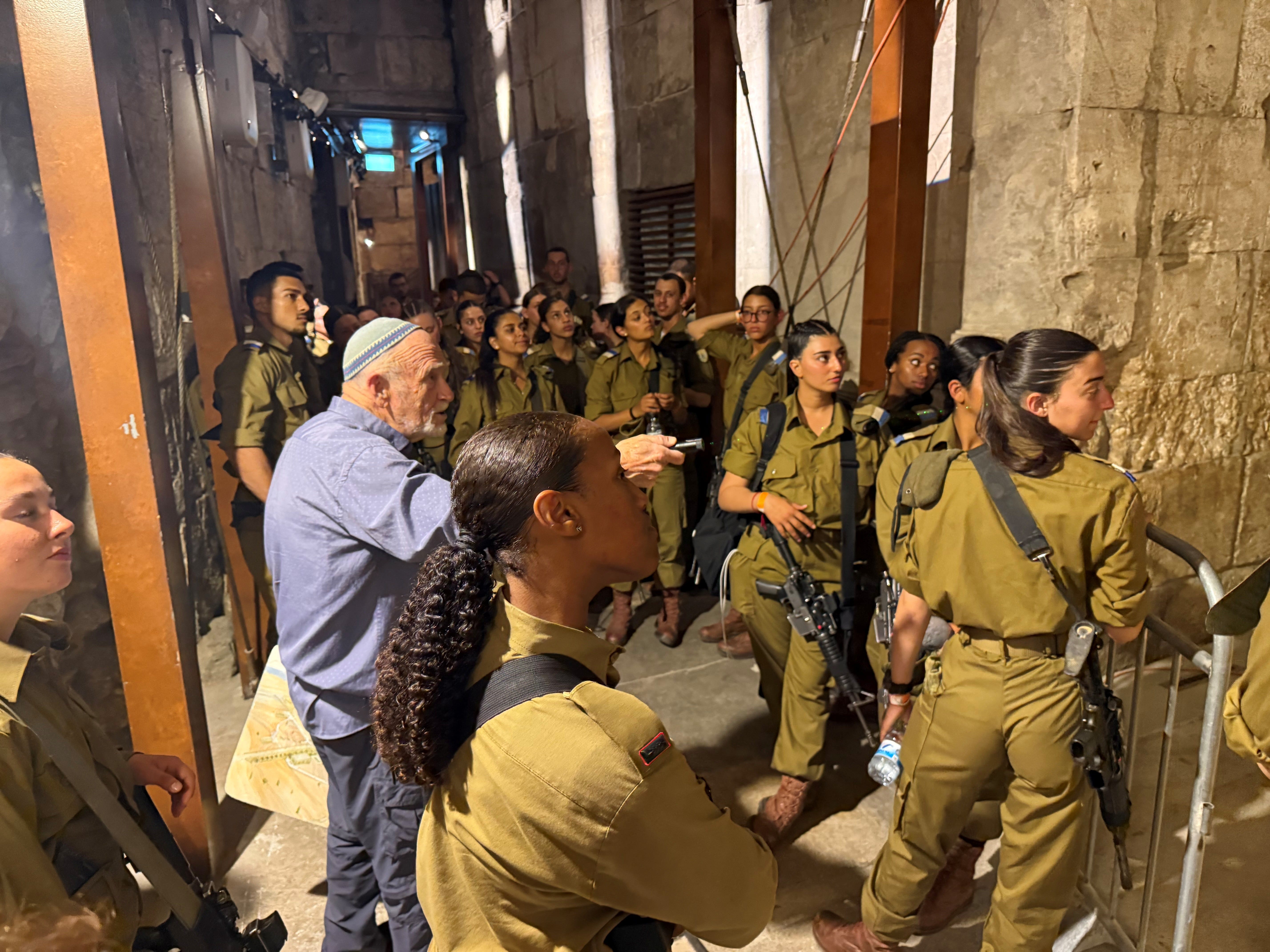
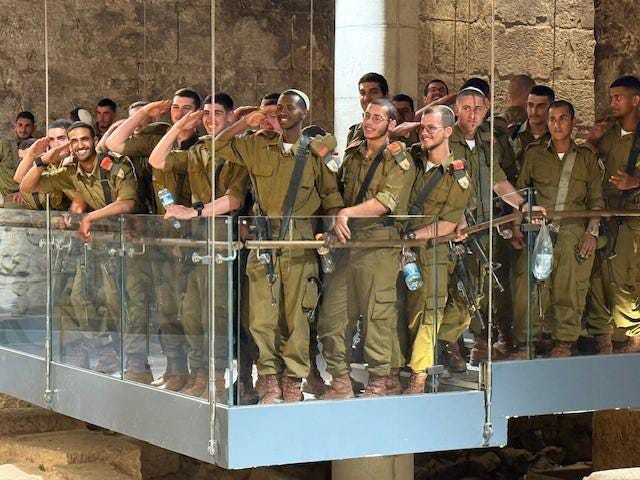
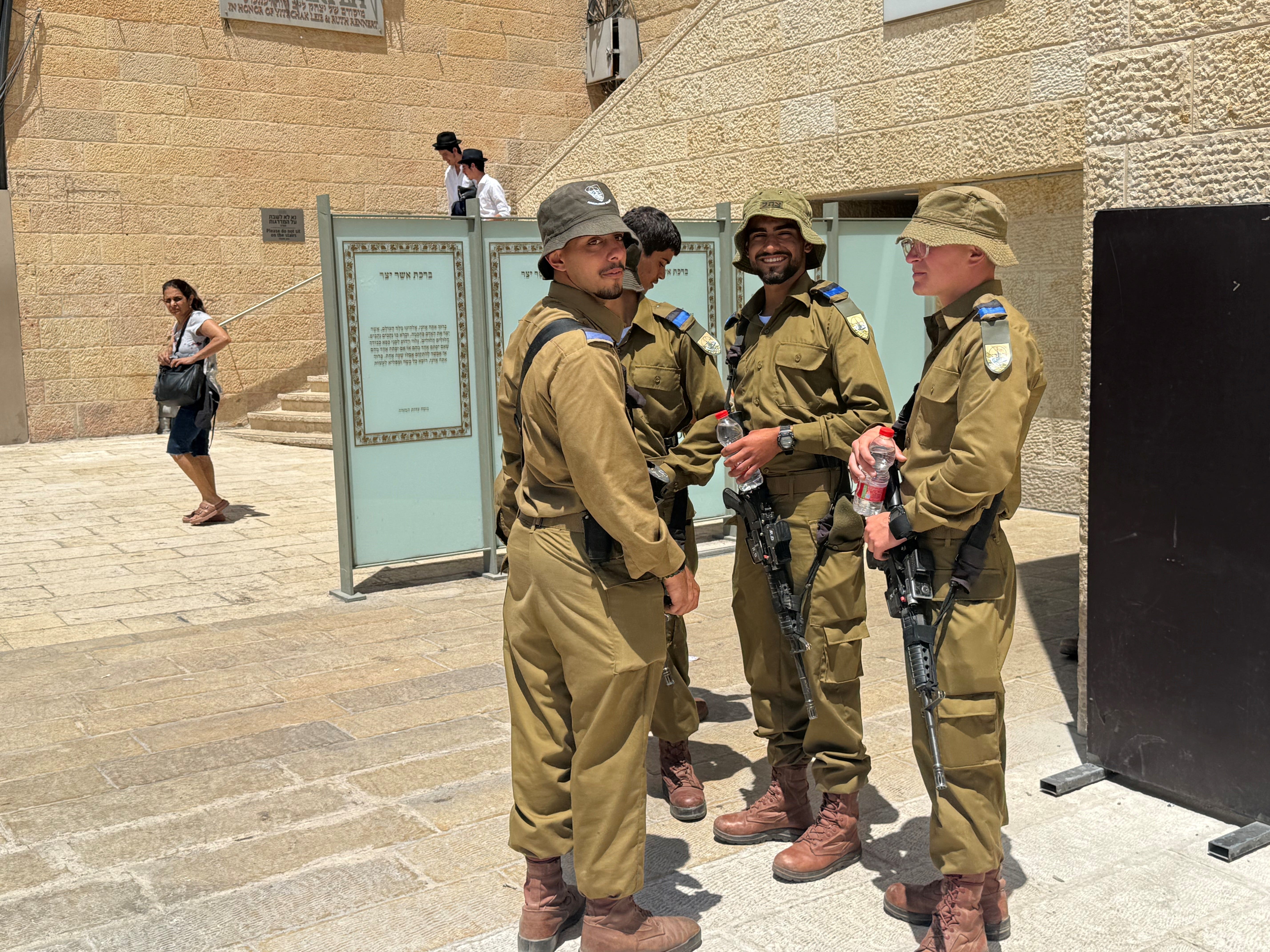
In fact, Mizrahi Jews (Jews of color) represent slightly more than 50% of the Jewish population. A picture is often worth a thousand words. I took these two photos of young IDF soldiers touring the excavation below the Western Wall as part of their training program[6] along with a photo of a small group of IDF soldiers standing in the plaza in front of the Western Wall.
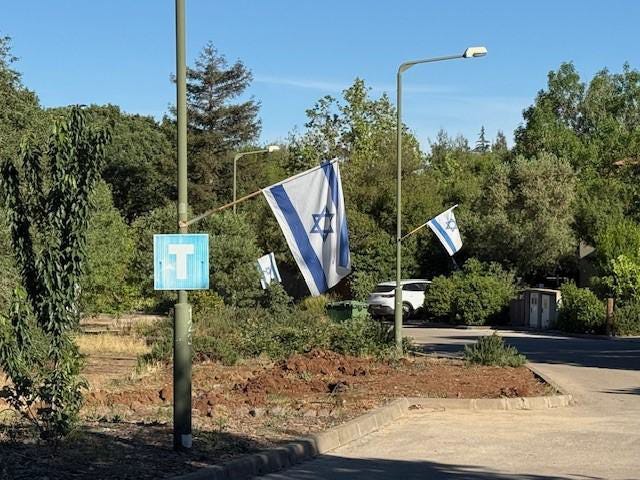
4. The level of Patriotism and Pride is Off the Charts: Everywhere we went in Israel, Susan and I saw Israeli flags – on office buildings, apartment buildings, and individual homes. The streets are lined with Israeli flags. They were everywhere we turned. This was but one visible symbol of the patriotism we saw day after day.
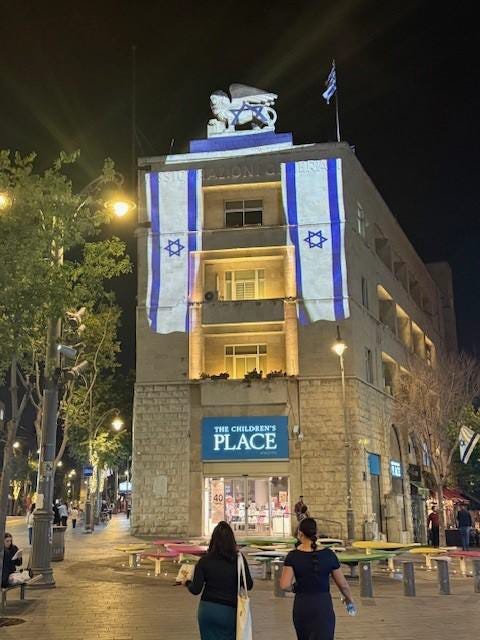
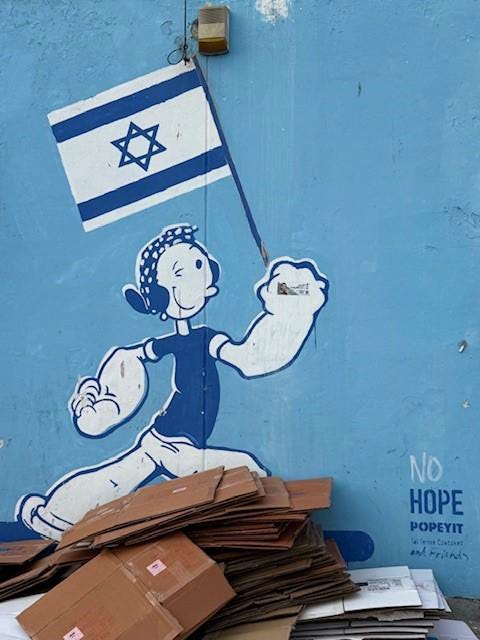
When we spoke with IDF soldiers, without exception they all were proud to be serving. This was equally true for career soldiers, young Israelis 18 to 20 years old serving their required 32 months of military service[7], and reservists in their 30s, 40s and 50s who had been called up for multiple tours of duty since October 7.
For each of them, this is an existential war, and they are prepared to risk their lives in defense of their family and their country. I can’t begin to describe how different this feels from America, where there is a deep sense of entitlement and a diminishing civic pride to be an American, and especially so among our youth. The difference between Memorial Day in the United States and Yom HaZikaron (Israel’s Memorial Day) is like night and day. In Israel, it is a very solemn day. Everyone in the country is acutely aware that these IDF soldiers died to keep Israel safe, making the ultimate sacrifice, and that this continues to be the case right now in the war that Israel is fighting ever since October 7.
For those of you who are cynical and think that the IDF soldiers we met might have been handpicked by AIPAC and not reflective of the broader sentiment, nothing could be further from the truth. Susan and I spoke to many, many IDF soldiers on our own, both on duty and in the reserves, and the message was consistently the same – “We are proud to serve our country.”
5. The Israel Defense Forces (IDF) is an Army of Ordinary People: In the Western press, the IDF is often portrayed as a heartless, genocidal force that kills innocent women and children. Nothing could be further from the truth! Much like the American army during the revolutionary war that was comprised of farmers and shopkeepers, the IDF is largely made up of ordinary citizens. Let me bring this to life with three short vignettes stemming from one-off, chance encounters that I will describe in chronological order. Note that this is but three of many people we met and talked to who served in the IDF. I think they will provide you with some real insight into the IDF and what it is all about.
At dinner a few nights before our departure, our waitress was an adorable young Israeli girl who might have weighed 110 pounds on a good day. When she brought us dessert, we asked her about her life. She nonchalantly told us she was a combat medic in the IDF, and between tours. Not exactly what we expected her to say.
A few days later, as we sat in traffic on our trip to the airport for our return flight, we struck up a conversation with the driver. He was a man in his early 50s built like an ox (not overly tall, but very broad with a handshake that felt like a vice). For security reasons, I will call him Yosef (not his real name). It turns out that Yosef is a captain in an elite Arab-speaking undercover unit (think, Fauda). His unit was comprised entirely of reservists who had served together for over 30 years.
Since October 7, Yosef’s unit had been deployed on multiple tours in Gaza doing undercover reconnaissance and tactical operations. He told us that he had already spent more than 250 days in Gaza, and that they were scheduled to be deployed again in early August, if not sooner. Of the 29 members of his unit at the start of the war, 10 have been killed or wounded to date. Yet there was no hesitation on Yosef’s part to go back into Gaza. “We have to get the job done,” he told us.
His unit went into Gaza immediately after October 7 to do advanced reconnaissance and try to ascertain the location of the hostages. To complete the picture for you, Yosef’s daughter is a career IDF officer with eight years of service. She is currently a captain in Unit 8200, the IDF’s elite intelligence unit which Iran tried to expressly target in its second missile attack against Israel. You could tell how proud Yosef was of her!
Our third chance encounter was at the airport. We were lucky enough to have VIP service where an airport agent named Doron (also not his real name) met our car, helped us check in for our flight, and took us through security. Doron was an attractive, athletic-looking Israeli in his early-to-mid 20s. While waiting in the various airport lines, we struck up a conversation with him. I asked Doron if he was in the IDF, and he told us that he was in the reserves.
Being my normal inquisitive self, I of course then bombarded Doron with a series of questions. It turns out that Doron served in a paratrooper unit. His unit had been on three deployments already, each lasting several months or more. The first was in Gaza, the second in Metula on the border with Lebanon, and the most recent again in Gaza. His unit had served for more than 280 days already (or said another way, Doron’s unit has served nearly 50% of the time that Israel has been at war).
While serving in the IDF, Doron was also studying at a university to get an accounting degree. Doron told us how hard it was to go back and forth into active duty and how difficult it was for him to keep up with the classes on his own. Although mild-mannered, Guy was beyond upset that the IDF was portrayed as “baby killers” in the media and spoke to us about that being the furthest thing from the truth. He recounted how they often voluntarily gave food and water to Palestinian civilians, and went to extreme lengths to try to keep Palestinians civilians safe. Very different from the narrative put forward my Western media!
Guy seemed far more worried about the rising antisemitism around the world and how Jews outside of Israel were faring than about his next tour of duty. He wanted to know how we were doing and whether we felt threatened in America.
*****************************
In my next monograph, which will be published on June 2, 2025, I will share five more of my takeaways from our recent visit to Israel. As always, please feel free to distribute this email as broadly as you would like. My goal in writing these emails is to educate as many people as I can.
If you received this email from a friend and would like to be added to the distribution going forward as well as read past monographs, they are all posted on Substack.com and can be accessed using the following link: tonybrenner.substack.com. Conversely, should you no longer wish to receive these emails, please let me know and I will stop sending them to you.
Finally, should you wish to email me directly, I can be reached at tony@pivotpointcap.com.
Take care,
Tony
[1] AIPAC stands for the American Israel Public Affairs Committee. Its mission is to strengthen and expand the U.S.-Israel relationship by encouraging the U.S. government to enact specific policies that create a strong, enduring and mutually beneficial relationship with Israel.
[2] The seven military fronts are: Gaza (Hamas), Lebanon (Hezbollah), West Bank (Palestinian terrorist groups), Syria (Iran-backed Shia militias), Iraq (Iran-backed Shia militias), Yemen (Houthis), and Iran (both directly and indirectly).
[3] We were fortunate to have booked our travel on El Al, Israel’s national airlines. Many people on our trip were scrambling to find alternative flights (with convoluted itineraries) to travel to and from Israel after their original flights on U.S. airlines were cancelled.
[4] For those of you who are not familiar with the movie, Star Wars, Episode IV, the bar scene is an iconic scene where a collection of bizarre intergalactic, alien species are assembled, drinking, smoking hookahs, and conversing.
[5] A lone soldier is someone who does not have family support in Israel, most often because they have made Aliyah (emigrated to Israel) on their own.
[6] In the IDF, a critical part of a soldier’s training is to develop an understanding of why they are fighting and what they are fighting for. This includes trips to cultural institutions and archeological sites so that they understand Jews connection to the land of Israel and have a better understanding of Israel’s history. I wish we did this here in America!
[7] Since October 7, required military service has been increased to 36 months due to manpower challenges.

Thank you, Lee! Please share with others who may have a distorted view on Israel. We need to try to overcome the media reporting that is beyond biased….
I have been reading your essay for the last few months, and I thank you for taking time to articulate your thought and shared them with us. It is a joy to read.